Nursing Home Physical Therapy for Purpose-Driven People
“I’ve got some balance exercises for you today,” says Morgan Dunn as he enters Larry Greenfield’s room. “You’re going to get a ride to the gym, and then I’m going to have you walk back down here when we’re done.”
Dunn is a physical therapist assistant (PTA) working with both long-term care residents and short-term rehabilitation guests at St. John’s Home. By “a ride” he means a push in his wheelchair, although Greenfield makes sure to get in a few useful swipes at the wheels as Dunn guides him towards the Reservoir 5 rehabilitation gym.
Dynamic Standing
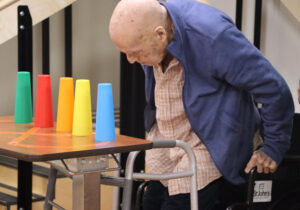
The exercises that Dunn has in mind for Greenfield this morning all focus on dynamic standing, which tests a person’s ability to stand and remain stable while moving and shifting weight. Because Greenfield’s goal is to return home, these physical therapy exercises are meant to test and build strength while performing multiple tasks. During the rehabilitation process Greenfield will also work with occupational therapy to perform simulated household tasks. These are activities we all must be able to perform to remain independent at home. The dynamic standing exercises Dunn has planned are designed to develop and display the strength needed to complete those tasks safely.
“I’m going to have you place these right on the floor,” Dunn explains, referencing five small cones he has lined up on the table in front of him. Greenfield rises from the wheelchair and, once standing, grips the walker placed between him and the table. He begins to grab each cone and bends over while arranging each cone on the floor, one by one. He announces the completion of the exercise when he places the last cone on the floor—a green one— by proclaiming “Greenfield” to an amused Dunn.
The second exercise, like the first, will limit Greenfield’s upper extremity support while standing, forcing him to keep his balance. As he tosses bean bags towards a box placed on the floor, he moves outside of his center of gravity as he repeats the routine of reaching for, gripping, and tossing the bags.
“Aren’t you going to ask me what this is for?” Dunn asks Greenfield, accustomed to him being an active participant in therapy sessions. Dunn explains that each physical therapy patient he has worked with over his eight-year career (three and a half years at St. John’s Home) is different. He does however point out that many of the people he works with, including Greenfield, benefit from exercises that sometimes look more like games.
Still Becoming Someone

Larry Greenfield is indeed a purpose-driven individual and he appreciates how Dunn approaches his physical therapy work. “I have great admiration for his commitment to his profession and to my well-being,” Greenfield says. He soon corrects himself, explaining that he much prefers to frame well-being as “well becoming.” Greenfield is a lifelong student of philosophy and the former President of Rochester’s Colgate Divinity School. As such, he has strong opinions about growing older and living a fulfilled life.
“To become is not to relax where you are,” he continues. “I have a life left to live, creatively. I’m not just looking to return to something from the past.” He references the philosopher Heraclitus, who argued that the fundamental capacity and essence of life is change and transformation. Greenfield talks about his own capacity building: “I’m not satisfied in being; I’m always wanting to do something new and become something new.”
Quality of Life
Whether he is working with a short-term rehabilitation guest moving towards returning to their home or another lower level of care or guiding someone living at St. John’s Home through strength and balance exercises, Dunn says preserving a person’s quality of life is key. “When it is someone in long-term care, we know that nobody wants to sit in their bed all day,” he says. The rehabilitation team at St. John’s Home works hard to navigate through insurance offerings to provide residents with support that enables them to live their lives with dignity and as much independence as possible.
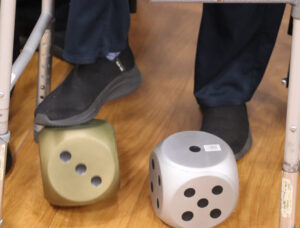
The final exercise of the day is another dynamic standing activity that Dunn says “increases the potential for functional mobility.” Only this time, Greenfield’s lower extremity support will be limited, testing his ability to maintain balance in a different way. As Dunn calls out numbers, Greenfield is tasked with using his feet to reposition two large foam dice to show sets of dots adding up to the number. “Bingo, you got it,” Dunn proclaims once Greenfield successfully completes the task.
Greenfield is now ten days through his second stint of rehabilitation at St. John’s Home. “I want to get back home, but if I have to stay, I know they (Dunn and other physical, occupational, and speech therapy professionals) have my best interests at heart,” he says.
As Dunn escorts his patient on the walk back to his room, he reminds him that he will see Greenfield again later that afternoon for a family care meeting with the therapy team. At the end of the walk, Greenfield is fatigued. However, he is more determined than ever to continue living his life in a way that conforms with what his world is becoming, not what it has been.