
“I think spirituality is important as we are growing up because we are always looking towards something,” says Patrick Crumity. “We are looking towards college, towards a career, towards marriage. However, the residents [at St. John’s] have accomplished all of that, so the next stage is spiritual.”
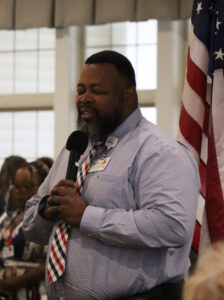
Known affectionately as “Pastor P,” “The Reverend,” or simply “Chap,” Patrick Crumity serves as a Spiritual Life Partner and Chaplain for St. John’s. He laughs about the many names, but embraces each one with humility and gratitude. “I know there is a lot of mutual respect.”
He joined St. John’s in 2020, but his spiritual journey began much earlier. Crumity says that he was “raised in the church” and is a third-generation pastor. He follows in the footsteps of his mother and grandmother.
“I started preaching at age 15,” he continues, “and did a lot of music in the church.” After high school, he enlisted in the United States Navy, where he found ways to serve others spiritually even overseas—leading choirs at orphanages in Ukraine. “I went into the Navy thinking I wanted to be something totally different,” says Crumity. “I came back, got married, had kids, and things changed.”
During the pandemic, Crumity started as a pastor at a local Methodist church. One day, a flyer for a part-time chaplain position at St. John’s caught his eye. “I applied, met with Sarah [Culp], and she chose me,” he recalls. Since then, he has served residents primarily at St. John’s Meadows and Brickstone by St. John’s, overseeing daily spiritual programs and services.
“It is interesting,” he says, “I was always hanging with my grandmother and older people in the church. So I have learned how to work with seniors, and sometimes their filter-less conversations — it has given me a love for it.”

“I am kind of an older soul, and now I have caught up to looking as old as I am,” jokes Crumity.
Crumity says that he prides himself on his approachable and friendly character. This has allowed him to have solid relationships with the residents of St. John’s.
“Most times, you see your pastor at church and then go home,” he explains. “Here, I’m in your home. We live and work together.”
Crumity’s open-door policy has made him a trusted member of the community. He says that residents and employees come to him not only for religious or spiritual guidance, but simply to talk.
“There are many people who are not church affiliated at all,” says Crumity. “When I’m at my office, they come and sit down and just start talking to me about life, about their beliefs, their non-beliefs, their children, and aging. My door is open.”
Crumity’s days can vary between one-on-one visits and spiritual programs. He says that in the five years he has been at St. John’s, the spiritual programs and offerings have evolved and grown. “The Catholic Bible Study I lead has grown to about 20 regulars in attendance.” One resident who participates in the weekly Bible Study is Pat Corcoran. “She stopped me one day,” says Crumity, “and she said, ‘Patrick, you changed my life,’ and I won’t ever forget that.”
Crumity says that Pat explained that though she was raised Catholic, she never sat down to read the Bible. “She told me that she never really had a good understanding of the teachings before the study group.”

In addition to the Bible Study, Crumity leads Ecumenical services, reads the homily for Catholic Mass, directs a resident choir, and coordinates guest clergy from various faiths, like Asbury Church. “We want residents who are still affiliated with their own churches to be able to practice here, so we have priests, preachers, and rabbis come in.”
One of the more “somber” parts of Crumity’s job is providing end-of-life spiritual guidance. “A lot of people are afraid of death and the afterlife, if there’s an afterlife,” says Crumity.
“So, when you can talk to them and assure them that whatever your belief is, you know, it’s nothing to be scared of,” he continues, “it is a thing you’re embracing, and it’s a part of life.”
He says that more than likely, this is the end of many residents’ natural lives. Therefore, providing comfort is crucial to make sure they are not living in stress. “If they believe that when they die, they’re going to become a flower. Okay, cool. I’m listening to you. Our job is not to judge, but is about being alongside them and listening.”
Crumity says that the role of the St. John’s Spiritual Care Team is “very vital” because they handle aspects of life that “are not visible.”

Throughout his time at St. John’s, Crumity has reevaluated aging and how he views it spiritually. “It’s all a process and you can’t stop it,” says Crumity. “I think that is where Spiritual Life comes in because you can’t stop the aging process. You can’t stop dying. You can’t. But you can get a sense of comfort from that.”
Crumity says that he thinks the St. John’s Continuum of Care helps alleviate some of the aging stress residents face. He says that a resident can start by living in a bungalow and then downsize by moving to a Brickstone apartment. “If that gets to be too much, they move to Meadows or Hawthorne, and then we have the Home.”
Along with the rest of the spiritual care team, Crumity makes it a cornerstone of his role to visit residents if they are in the hospital or at another St. John’s campus. “The other day I stopped by rehab at St. John’s Home to see one of my Bible Study students and her face just lit up,” says Crumity. “I truly think I bring a sense of calmness that they need or do not even know they need.”

“I am a very intentional and purpose-driven person,” says Crumity. “If I feel like what I’m doing is not purposeful and void, that I don’t feel like I’m needed, then I don’t waste time doing it because life is short.”
At St. John’s, that purpose is renewed every day.
“This is the first job since pastoring that I look forward to coming into work because it is a lifestyle here.”
Crumity says that coming into work, seeing residents, and the community itself fulfill his purpose. He mentions that although holding memorial services for residents with whom he has grown close is “the hardest part of the job,” he says that he is grateful for knowing and learning from them.
“As much as I give through my work, I have learned to receive,” says Crumity. “Being here, doing this kind of work, I get just as much as I give, and it’s a recyclable thing. It’s a synergetic thing. That’s why I do it. I love doing it.”